
Foil Stamping & Foil Printing
What it is, how the process works, what it costs, and what makes it the right choice for your project.
What is foil stamping?
Foil stamping is a printing process that uses a heated copper die to transfer thin metallic or pigment film directly to paper. The result is a crisp, completely opaque, metallic or colored impression.
A copper die engraved with your design is mounted in the press and heated to a specific temperature — typically between 200–250°F depending on the foil type and paper. The foil roll sits between the die and the paper. When the die presses down, the heat and pressure cause the foil to release from its carrier film and bond permanently to the paper surface, precisely following the engraved design.
Unlike letterpress inks, which are translucent and pressed into the paper, foil sits on top of the paper surface as an opaque metallic or pigment layer. It fully covers whatever is beneath it.
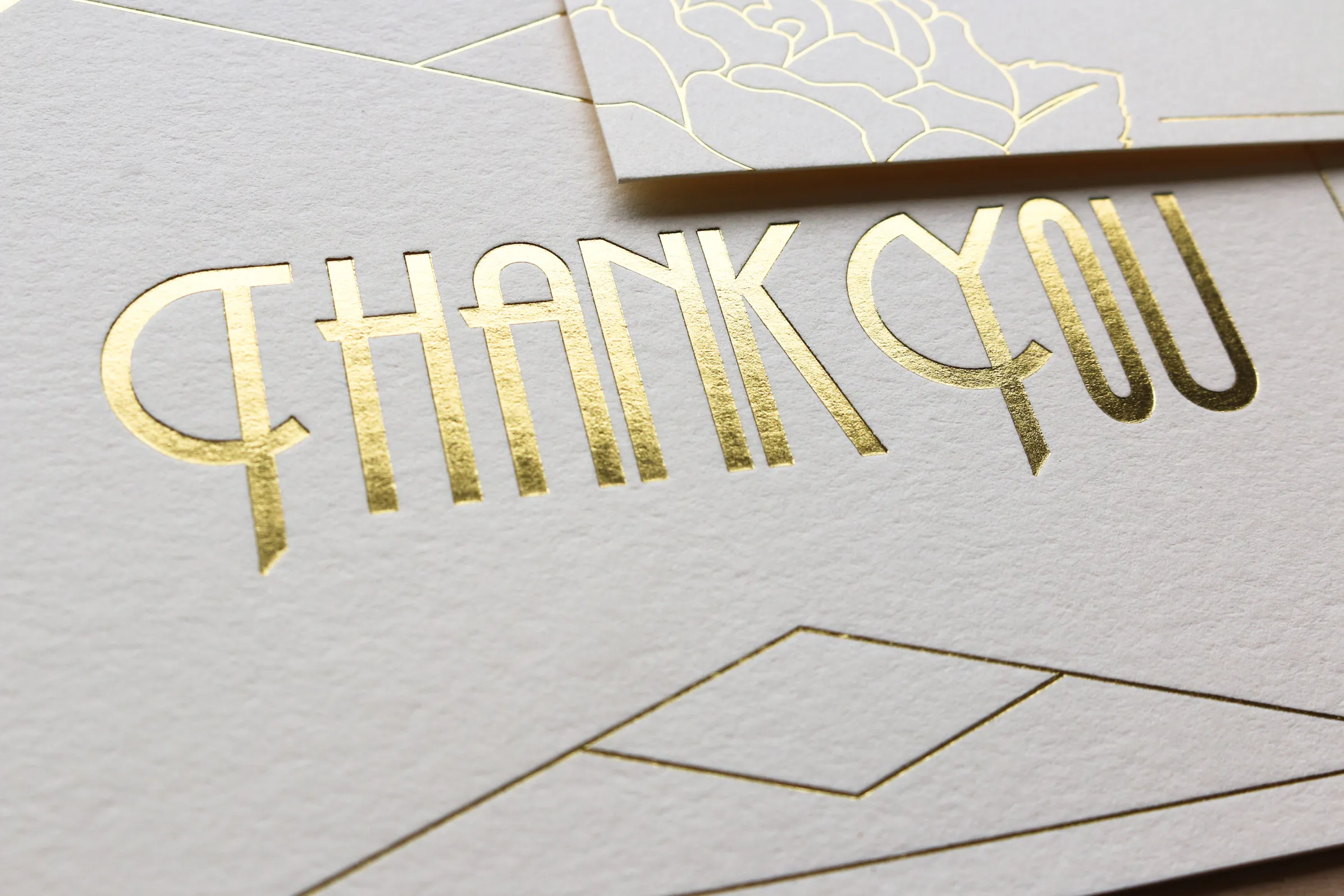
What is the difference between foil stamping, foil printing, and hot foil stamping?
They are all the same process. The different names come from different industries and time periods, but describe identical technique.
"Hot foil stamping" emphasizes that the die is heated. "Foil printing" is used more in commercial contexts. "Foil stamping" is the traditional stationery term. "Gold stamping" or "gold foiling" refer to the same process when a gold foil is used. They all mean: heated die + foil film + paper = metallic impression.
Why use foil stamping instead of metallic ink?
Foil stamping creates a genuine metallic surface. Metallic ink creates the appearance of metal using pigment suspended in ink — and nothing matches the reflectivity of real foil.
Metallic inks contain small metallic particles (often aluminum) that are intended to give a metallic look. They can look fine in some applications. But if you hold them up to light, they look flat compared to actual foil. Foil is a thin metal film — when you rotate a foil-stamped piece in light, it behaves like a metal surface because it is one.
For wedding invitations, business cards, and packaging where quality signals matter, foil stamping is the correct choice. Metallic ink is the budget substitute.
What can foil stamping be used for?
Foil stamping works on any print piece that needs a metallic, high-shine, or opaque colored detail. Common uses include wedding invitations, business cards, letterheads, note cards, book covers, hang tags, packaging, and certificates.
- Wedding invitations — gold or rose gold foil on cotton paper is a classic combination
- Business cards — foil logos, names, or accents create a tactile premium impression
- Hang tags and packaging — foil stamping elevates product presentation at the point of contact
- Note cards and stationery — foil initials or borders on note cards are a timeless detail
- Envelopes — foil addressing or return addresses on colored envelopes
What foil colors are available?
We stock golds (warm gold, bright gold, matte gold, regal gloss), coppers, rose gold, bronze, silvers, holographic, white, black, pale blue, and specialty pigment foils.
We source foil from several suppliers and can find almost any color — including custom matches and seasonal or specialty foils not in our standard stock. See our complete foil color reference for names and codes.
What papers work best with foil stamping?
Smooth and lightly textured papers give the cleanest foil coverage. Heavily textured papers can produce incomplete coverage in the recessed areas of the texture.
Most papers suitable for letterpress work well with foil — Crane's Lettra, French Paper, Colorplan, Gmund, and standard cover stocks all accept foil cleanly. Very rough surfaces (uncoated newsprint, cotton rag with high texture) are more challenging. When in doubt, we can test your paper with foil before committing to a full run.
One significant advantage: foil works on any paper color. Gold foil on black paper is fully legible. White foil on navy paper reads clearly. This is because foil is opaque — unlike inks, which are translucent.
Can foil stamping be combined with letterpress printing?
Yes — this is one of our most popular combinations. Each technique runs as a separate press pass on the same piece.
A typical multi-technique piece might use letterpress for the main text (giving depth and impression) and foil stamping for a logo, monogram, or border (giving metallic shine). The two techniques complement each other because they operate differently — letterpress creates depth; foil creates surface shine.
The key to a clean combined piece: keep foil areas and ink areas fully separated in your design file. They will be output as separate plates and run on separate passes.
Can foil stamping print light colors on dark paper?
Yes — this is one of foil's primary advantages over ink. Foil is fully opaque and prints true regardless of paper color.
White foil on black paper, gold foil on forest green, rose gold on burgundy — all are achievable because the foil fully covers the paper beneath it. Letterpress inks can't do this cleanly because they're translucent. If your design requires a light color on a dark paper, foil stamping or white ink digital printing are the two correct options.
What are the limitations of foil stamping?
Foil stamping is not ideal for fine halftones, gradients, photographs, or very fine reversed-out type. It works best with clean vector designs, solid fills, and bold strokes.
- No gradients or halftones — foil is either on or off. You cannot achieve a gradient with foil; it stamps solid areas only.
- Minimum line weight — very fine lines (under 0.25pt) may not stamp cleanly; details can close up or break.
- Reversed-out type — small reversed-out (knockout) text can be challenging; the foil may fill in small counters (the holes inside letters like 'o' and 'e').
- Heavily textured papers — as noted above, deep texture can cause incomplete coverage.
- Color matching — foil colors cannot be Pantone-matched the way inks can. We select from available foil colors that are closest to your target.
Design tip: preparing files for foil stamping
Provide your foil art as a separate layer or file from your ink art. All foil areas should be 100% black fill with no stroke — do not use spot colors for the foil layer. Provide vector artwork (AI, EPS, or PDF with embedded fonts) at final trim size. Minimum safe line weight: 0.5pt. Minimum reversed type: 7pt for serif, 6pt for sans-serif.
Frequently asked questions about foil stamping
-
How much does foil stamping cost?
Foil stamping costs depend on quantity, size, number of colors, and paper choice. The copper die is a one-time setup cost; subsequent runs are more economical. Request a quote for your specific project — we'll itemize die costs, run costs, and paper separately so you can see exactly what you're paying for.
-
What file format do I need for foil stamping?
Vector artwork is required for the copper die engraving — AI, EPS, or high-resolution PDF with all fonts embedded or outlined. Raster images (JPEG, PNG) are not suitable because they can't be cleanly scaled for die engraving. The foil art should be provided as a separate file or layer from your ink art, 100% black fill, no stroke.
-
Does each foil color require its own copper die?
Yes. Each foil color requires its own copper die. If you're using two foil colors (say, gold and silver), that's two dies and two press runs — each priced separately. This is why most foil jobs use one or two colors at most.
-
How long does foil stamping take?
Standard turnaround is 2–3 weeks after design approval and deposit. Rush options are available depending on our production schedule. Die creation alone takes 3–5 business days, which is why final artwork needs to be approved before we can begin.
-
Can I see a proof before the full run?
Yes. We provide digital proofs for layout approval before production. For clients who want to see the foil color and feel on their actual paper, we can arrange a press proof (additional cost) before the full run. This is worth doing for large quantities or unusual paper/foil combinations.
Ready to add foil stamping to your project?
We'll help you choose the right foil color, paper, and combination of techniques for your project. Start with a quote or browse our foil color options.
Request a Quote Browse Foil Colors