
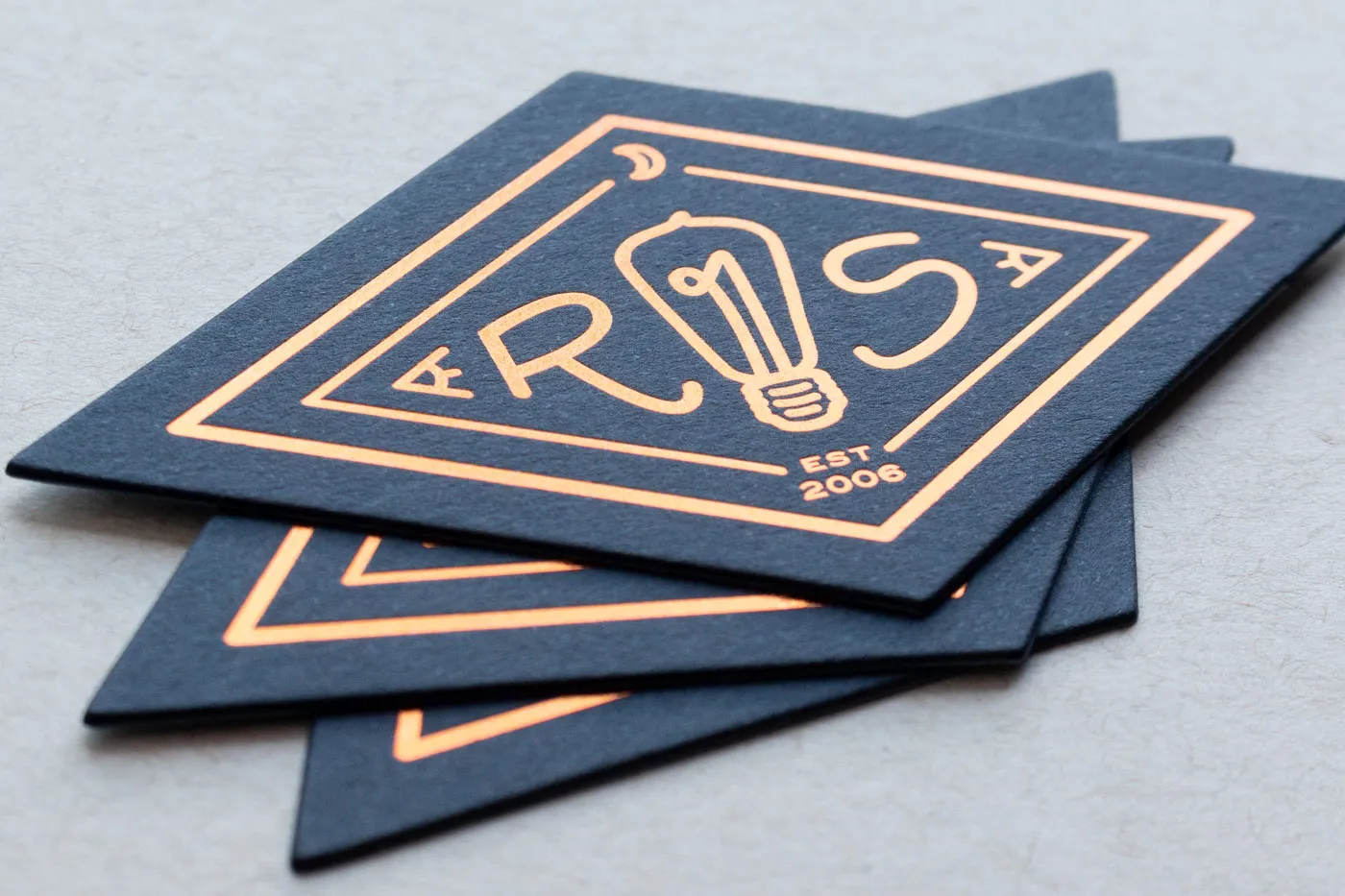
The shape of a piece of stationery is part of the design. Die cutting lets us move beyond the standard rectangle — adding rounded corners, arch tops, notched edges, or fully custom silhouettes that become part of the visual identity of your printed piece.
What is die cutting?
Die cutting uses a steel-rule die — a custom blade formed into a precise shape — pressed through paper to cut each piece identically. Every run comes out uniform in shape, cleanly cut, and ready to use.
The die is made from your artwork as a one-time setup. Once made, it stays on file for reorders, so you never pay for the die again on repeat orders.
What shapes are possible with die cutting?
Almost any shape: rounded corners, arches, circles, ovals, hexagons, diamonds, scalloped edges, custom silhouettes. Interior cutouts (like a keyhole or window) are also possible with a steel-rule die.
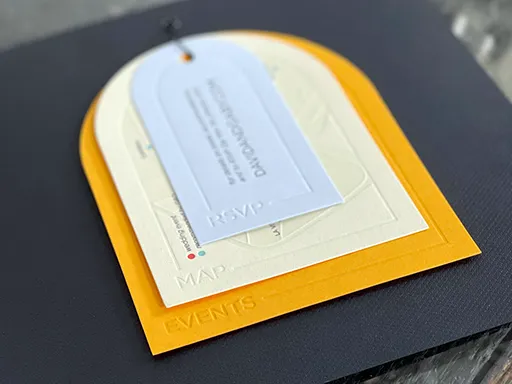
Some common die cut applications:
- Business cards — rounded corners, arch top, diamond or oval shapes
- Hang tags — custom silhouettes, arched tops, shaped to match a product label
- Invitations and notecards — arched cards, shaped enclosure cards, scalloped edges
- Labels — circles, ovals, custom label shapes for candles, bottles, jars
- Packaging — folding cartons, custom dust covers cut to shape
How does die cutting work with letterpress printing?
Die cutting is a separate pass — typically the last step after printing. The design is printed first (letterpress, foil, digital, or any combination), then the die is used to cut the final shape.
The die is aligned to match the printed design so the cut registers precisely with the artwork. A business card printed with letterpress, foil stamped, and then die cut into a diamond is a single coordinated process from start to finish.
What is the difference between die cutting and laser cutting?
Die cutting uses a physical blade — fast, precise, and cost-effective for most shapes. Laser cutting uses a focused laser beam and can achieve much finer detail, interior filigree, and intricate patterns that steel-rule dies cannot produce.
- Steel-rule die cutting — lower cost, faster, ideal for bold shapes and rounded corners
- Laser cutting — higher cost per piece, can cut or score extremely fine detail and interior cutouts
For most stationery projects, steel-rule die cutting is the right choice. Laser cutting is reserved for projects where the intricacy of the cut is itself a design feature.
How much does a custom die cost?
Custom die cost is a one-time setup fee that varies by shape complexity and size. Simple shapes (rounded corners, arches) cost less than complex custom silhouettes. The die is kept on file and used for all future reorders at no additional die charge.
Standard rounded corners have the lowest die cost — a common upgrade for business cards and note cards that adds a polished, premium feel without a large added expense.
Die cutting on every reorder
Once we make a die for your project, it's filed under your account. Every future reorder uses the same die at no additional setup cost. If you're considering die cutting for the first time, it's worth thinking about whether you'll want consistent shapes on future print runs — which makes the one-time die cost even more worthwhile. Request a quote to get started.